


Background
Technology is often the most underestimated risk in transactions and is one of the hardest synergies to realise post-deal.
Although it enhances scalability, operational performance and decision-making, many deals suffer from delayed integrations, underestimated data and system complexity, vendor lock-in, and unclear ownership of execution. This leads to cost overruns, operational disruption, and negative impacts on deal value.
At PryceWilliams, we help manage the risk of technology in transactions and ensure that your outcomes are delivered. Our specialist consulting and project delivery services are tailored to your challenges in assessing, implementing and integrating new technologies. Our expertise spans vendor assessments, migrations, operational optimisation and technological change management.
Approach
This guide is designed for investors, acquirers, sellers and management teams navigating the technology implications of a merger or acquisition.
We address:
- The common technology challenges facing acquirers and sellers
- The critical priorities during integration or separation
- How disciplined execution protects and enhances deal value
To do this, we explore the following questions:
- What makes technology execution complex in M&A transactions?
- What should acquirers and sellers prioritise pre- and post-deal?
- How can structured technology execution reduce risk and accelerate value realisation?
- How do we approach integration, separation and system alignment?
- What types of technologies and operating environments have we supported?
Analysis
What makes technology execution complex in M&A transactions?
Technology execution in M&A is complex because systems, data and vendors (3rd party technology suppliers) are embedded in day-to-day operations. Due Diligence often focuses on the financial implications of the transaction, and often the operational, data and system aspects are not given due consideration due to time constraints.
Common sources of complexity include:
- Incomplete visibility pre-deal: Legacy systems, embedded system workarounds and vendor dependencies may not be uncovered during high-level deal due diligence.
- Operating model alignment: Integrating technology platforms between organisations requires more than the ability to connect systems to one another. The data, workflows and outputs upstream and downstream need to align across each organisation to perform a successful migration.
- Conflicting priorities post-close: Leadership’s priorities post-deal can conflict as attention shifts more to delivering synergies and driving growth. Responsivity and ownership for stabilising the operating model and integrating technology to realise the expected value can be unclear.
- Vendor and contractual constraints: Failure to fully understand the structure of agreements held with vendors may present unwanted costs and obstacles to growth post-deal. This leads to a failure to rationalise vendors and the associated costs.
- Cultural and governance differences: A lack of clarity on oversight and governance models can result in inefficient decision-making and friction, which slows progress.
Proper planning, oversight and execution can help mitigate these factors to preserve deal value and avoid budget overruns and disruptions to operations.
What should acquirers and sellers prioritise pre- and post-deal?
In our experience, these are some of the key questions to ask to ensure deal value is realised:
| When | Priority | Questions |
|---|---|---|
| Pre-Deal | Technology risk identification |
|
| Pre-Deal | Alignment to deal |
|
| Pre-Deal | Integration planning |
|
| Post-Deal | Establishing stability |
|
| Post-Deal | Clear Integration governance and processes |
|
| Post-Deal | Data and reporting alignment |
|
| Post-Deal | Early Wins with measurable impact |
|
How can structured technology execution reduce risk and accelerate value realisation?
Structured execution provides:
- Clarity - A clearly defined technology plan aligned to the deal prevents scope creep and wasted investment.
- Control - Early identification of integration complexity, vendor constraints and data risks allows proactive mitigation.
- Measurable progress - Phased delivery with defined outcomes reduces uncertainty and improves stakeholder confidence.
- Alignment - Technology decisions are evaluated through a value lens of scope, cost, time and quality.
- Governance and Accountability - Structured oversight ensures decisions are made quickly and there is a clear understanding of negotiables and non-negotiables
How do we approach integration, separation and system alignment?
Our approach is driven by outcomes, tailored to your specific circumstances and follows six key phases. We bridge the gap between leadership and technical teams.
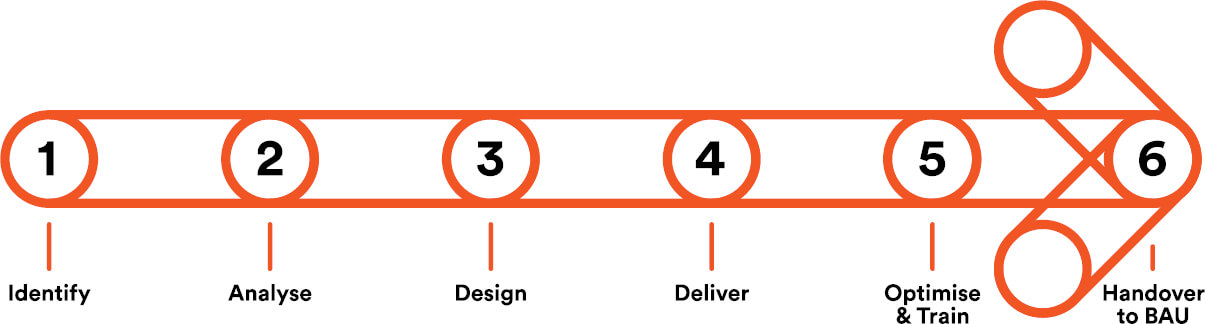
| Phase | Activities | Outputs |
|---|---|---|
| 1. Scope |
|
|
| 2. Analyse |
|
|
| 3. Design |
|
|
| 4. Deliver |
|
|
| 5. Optimisation and training |
|
|
| 6. Handover to BAU |
|
|
What types of technologies and operating environments have we supported?
Our experience spans diverse and complex environments supporting scale-ups, carve-outs and established businesses, including working with:
| Type | Examples |
|---|---|
| Enterprise platforms |
|
| Data & analytics environments |
|
| Operational systems |
|
| Cloud & infrastructure |
|
| Vendor & managed service landscapes |
|
Conclusions
Technology is an enabler in extracting value from transactions and ensuring that strategic outcomes are realised. However, technology alone isn’t enough; the key is execution.
Whether integrating platforms, separating systems, or aligning digital capabilities to a new operating model, complex technology environments can quickly undermine deal assumptions if not actively managed. Delayed integrations, unclear governance, vendor constraints and weak adoption can erode anticipated synergies and distract leadership from strategic priorities.
PryceWilliams brings structured, proven oversight to technology execution in transaction environments. We coordinate stakeholders, manage vendor ecosystems, and align delivery and integration across key functions (e.g. Finance, Technology, Operations and Risk). By combining disciplined programme management, an understanding of end-to-end processes and a clear focus on measurable outcomes, we help organisations stabilise quickly, reduce risk and realise value.
Recommendations
At PryceWilliams, we combine project management with our transformation expertise to address your challenges.
| How we can help | What that means |
|---|---|
| Define value and risk upfront | Establish measurable success criteria aligned to the deal thesis — including cost synergies, scalability, reporting alignment and risk mitigation — before integration or separation begins. |
| Implement structured governance early | Assign clear cross-functional accountability, define decision rights, and create escalation pathways to maintain pace and control throughout the transaction lifecycle. |
| Stabilise before optimising | Prioritise business continuity and reporting integrity before pursuing system enhancements or broader transformation initiatives. |
| Assess and align the vendor landscape | Evaluate licensing structures, contractual obligations and service dependencies to avoid cost surprises and operational disruption post-close. |
| Prioritise adoption and operating model alignment | Ensure processes, roles and data ownership are clearly defined so that technology changes translate into sustainable operational improvement. |
| Engage early in the transaction lifecycle | Early involvement enables realistic planning, clearer risk identification and smoother execution from Day 1 through stabilisation. |
By applying these principles, organisations can reduce integration risk, maintain operational stability and convert technology from a transaction liability into a source of measurable, sustainable value.
Next steps
At PryceWilliams, we specialise in helping investors, acquirers, sellers and management teams navigate successful transactions.
Our people-led approach ensures your projects are in safe hands. Contact us today for a confidential discussion on mitigating technology risk in M&A transactions, identify opportunities and make progress happen.
